



Understanding your unique curl pattern is the foundation of effective hair care. From gentle waves to tight coils, each texture has distinct needs due to the fundamental differences in hair structure. This comprehensive guide provides evidence-based product recommendations for textured hair, followed by tips for application and use that make these more effective.
Identifying Your Hair Type
Understanding why certain products work requires exploring the unique characteristics of each hair type. Curly hair types mainly depend on follicle shape, which ranges from slightly oval to elliptical, creating the signature pattern that defines each hair type.
Wavy Hair
Wavy hair grows from oval-shaped follicles. This hair type can feel a little drier than straight hair because it is more challenging for sebum to distribute.
Wavy hair encompasses three categories, each with specific characteristics:
- Type 2A: a slight wave pattern that remains bendable and straightens easily.
- Type 2B: develops a loose S-pattern reminiscent of natural beach waves, though typically with minimal bounce.
- Type 2C: the most defined S-pattern with deep waves that create noticeable texture and volume.
Curly Hair
Curly hair comes from oval to elliptical-shaped follicles. This hair type can be loose spirals with minimal shrinkage, springy ringlets, or tight corkscrew curls.
There are three curly hair types:
- Type 3A: features loose spiral curls with minimal shrinkage, typically measuring the diameter of a thick permanent marker.
- Type 3B: springy ringlets with tighter curl formation that springs back one to two inches when pulled, often comparable to pencil-width.
- Type 3C: tight corkscrew or zigzag patterns with maximum curl definition.
Coily Hair
Coily hair grows from flat, elliptical hair follicles. This hair type presents as tight curls wrapping around themselves, dense zigzag curls, or tightly coiled curls to the point that you may only see the zigzag pattern if you stretch the strands.
There are three distinct coily types:
- Type 4A: features coily patterns where curls wrap around themselves, with a defined "S" pattern. It is typically the most moisture-retentive of coily types.
- Type 4B: possesses a sharp zig-zag pattern rather than a defined curl. It is often soft but very fragile and prone to breakage.
- Type 4C: tightly coiled hair that you may not see the zigzag pattern unless actively stretching the hair. This is the most fragile of the coily types and experiences the most dramatic shrinkage.
Best Products for Wavy Hair
Wavy hair needs lightweight moisture that enhances its natural S-pattern without weighing down the delicate wave structure or creating excess oil at the roots.
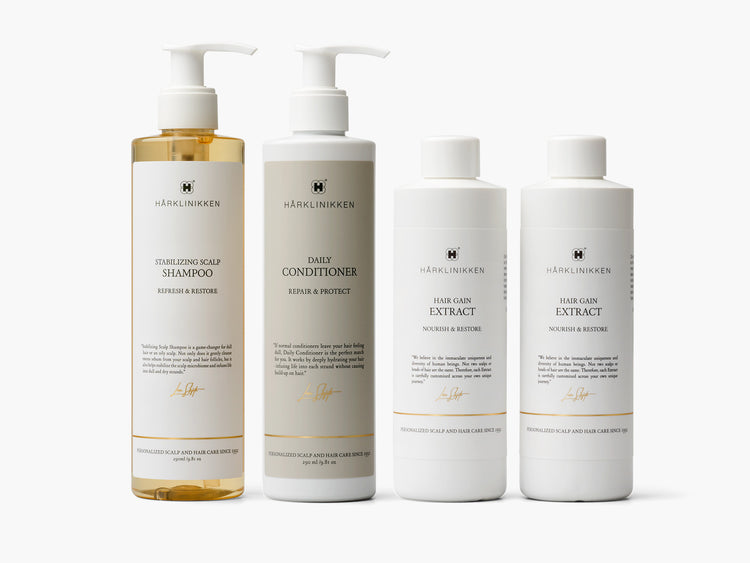
Fortifying Shampoo: Choosing between our Balancing Shampoo and Stabilizing Scalp Shampoo mostly depends on your scalp type. However, using the Fortifying Shampoo as an add-on for your regular cleansing routine strengthens hair structure and delivers the moisture that supports wavy hair.
Daily Conditioner: This daily formula provides intense hydration without silicones, avoiding the heavy, weighed-down feeling that can flatten waves. This award-winning formulation ensures your waves maintain their natural bounce and movement.
Hair Hydrating Crème: This multipurpose formula for wavy hair offers heat protection during styling while increasing luster and elasticity. Apply to damp hair to seal the cuticle and prevent humidity-induced frizz that disrupts wave patterns and help waves maintain their structure throughout the day.
Hair Mask: Use as both a pre-shampoo treatment and leave-in treatment to protect from damage and breakage. This rich, reparative formula leaves hair feeling softer, smoother and deeply replenished with emollient Abyssinian and avocado oils.
Styling Spray: Specifically formulated to combat wavy hair's tendency to lack volume at the roots while waves fall flat over time. This aerosol-free spray creates lasting lift at the crown and enhances natural S-patterns throughout the lengths.
The Best Products for Curly Hair
Curly hair requires intensive hydration and curl-enhancing products that combat frizz while maintaining the springiness and definition of spiral and ringlet patterns.
Fortifying Shampoo: Not only does this formula nourish the scalp with actives such as niacinamide and aloe vera, but it also adds crucial moisture to curly hair.
Daily Conditioner: A great conditioner for curly hair when left on for five minutes or longer. For Type 3B and 3C curls that need extra definition, try double conditioning: apply conditioner to lengths before shampooing to protect your curls from sudsy shampoo, then shampoo at the scalp only, rinse, and apply a second coat of conditioner from mid-length to ends. This technique enhances springiness and prevents frizz.
Hair Hydrating Crème: Apply to damp hair section by section, using praying hands or scrunching methods to encourage curl clumping. When used with a wide-tooth comb, it becomes an effective detangler that helps separate curls without disrupting their natural pattern. The lightweight formula won't weigh down ringlets or reduce bounce.
Hair Mask: As a pre-shampoo treatment, it shields curls from moisture loss during cleansing. As a leave-in styling product, apply generously to soaking wet hair and scrunch to create defined, frizz-free curl clumps. Applied several times a week as a deep treatment, it helps restore elasticity to curls that have lost their spring.
Styling Wax: Perfect for Type 3A and 3B curls that need lightweight definition without crunch. Emulsify a small amount with water in your palms, then scrunch into damp (not wet) hair focusing on mid-lengths to ends. This creates soft, touchable curls with natural movement and shine while sealing in moisture and controlling frizz throughout the day.
Best Products for Coily Hair
Coily hair requires maximum moisture retention, gentle detangling solutions, and products that protect its fragile structure while managing shrinkage and maintaining definition through dense, tightly coiled patterns.
Daily Conditioner: This should be the foundation of moisture retention for coily hair. For Type 4 coils, leave on for a minimum of 5-10 minutes to allow deep penetration into the tightly coiled hair shaft. Double conditioning is highly recommended: apply a generous amount to dry or damp hair before shampooing, focusing on the lengths and ends. This creates a protective barrier during cleansing. After shampooing only the scalp, apply conditioner again from root to tip and leave on for an additional 5 minutes. This protocol is essential for Type 4C hair, which experiences severe moisture loss.
Hair Hydrating Crème: Your primary detangling tool for high-density coily hair. Apply liberally to soaking wet hair in sections, then use a wide-tooth comb to gently work through from ends to roots. The slip it provides is crucial for Type 4B and 4C hair to prevent breakage during the detangling process. Can also be used daily between wash days to refresh coils and add moisture without build-up.
Hair Mask: Most versatile for coily hair's unique needs. As a pre-shampoo treatment (highly recommended for Type 4B and 4C), coat dry hair generously 30 minutes before washing to protect fragile strands and minimize moisture loss during cleansing—critical for accessing the scalp through dense coily hair. As a leave-in styler, apply to wet hair in sections and don't rinse—this locks in maximum moisture and provides hold for twist-outs, braid-outs, and wash-and-go styles.
Styling Wax: Ideal for Type 4A coils and for sealing moisture into Type 4B and 4C hair. Mix a generous amount with water, then apply to damp or soaking wet hair in sections using the shingling method for maximum coil definition. The heavier application works with coily hair's density rather than weighing it down. Excellent for twist-outs and braid-outs when applied to each section before twisting.
Hårklinikken and the Curly Girl Method
You cannot explore curly hair routines without coming across the popular Curly Girl Method, which has become a go-to guide for managing textured hair, emphasizing moisture retention, and gentle care. While this method has brought mainstream attention to ingredient awareness in curl care, Hårklinikken's approach is rooted in decades of advanced hair and scalp science.
Our formulations are developed over many years and are based on understanding of how specific ingredients interact with curly hair structure and scalp health, while at the same time having focus on how to optimize conditions for hair growth. We exclude not only silicones, mineral oil, and parabens, but also synthetic fragrances, colorants, and numerous other compounds that can compromise hair integrity and scalp function and eventually optimal hair growth.
Our exclusion of silicones, for example, goes beyond the basic principle that they can coat the hair shaft. We understand that these synthetic polymers create a barrier that prevents essential constituents from reaching the hair cortex, disrupt the scalp's natural microbiome when coming in contact with the scalp, and can lead to product buildup that weighs down curls and dulls their natural pattern. For curly hair, which already faces challenges with moisture distribution from root to tip due to its structure, this barrier effect is particularly detrimental to long-term hair health.
Similarly, mineral oil, a petroleum-derived occlusive, sits on top of the hair rather than absorbing into it, creating an impermeable layer that blocks essential moisture penetration while potentially clogging follicles and interfering with natural sebum production.
Parabens, widely used as preservatives, raise concerns that extend beyond the scalp itself—these compounds have been associated with potential endocrine disruption, possible links to certain health conditions, and environmental persistence that affects aquatic ecosystems when washed down the drain.
This science-first approach ensures that Hårklinikken products support the unique needs of textured hair through active nourishment rather than temporary cosmetic effects.
Where Scalp Science Diverges: The Shampoo Debate
One of the most popular aspects of the Curly Girl Method is "co-washing," skipping traditional shampoo in favor of cleansing conditioners to avoid stripping natural oils. While this approach focuses on protecting the hair shaft, it overlooks a critical factor: scalp health.
The scalp is like facial skin, it requires thorough cleansing to remain healthy. Product buildup, sebum (oil from the glands), bacteria, dead skin cells, and environmental pollutants accumulate on the scalp and can lead to inflammation, clogged follicles, and an imbalanced scalp microbiome.
An unhealthy scalp can directly impact the hair quality and hair growth, regardless of how well you care for the hair shaft itself. When the scalp becomes congested with buildup, it may trigger inflammation that disrupts the hair growth cycle, weakens follicles, and even contributes to hair thinning over time. For individuals with high-density coily hair, thorough scalp cleansing becomes even more critical, as it's already challenging to access the scalp through dense curl patterns.
Our Approach: Cleansing with Naturally Derived Formulas
Rather than following a one-size-fits-all rule like avoiding shampoo altogether, Hårklinikken takes a personalized approach to scalp cleansing with formulas that use naturally derived cleansing agents. We recognize that every individual's hair and scalp have unique needs based on factors like texture, density, porosity, scalp oil production, lifestyle, and environment.
Some clients with oilier scalps or fine curly hair may benefit from daily shampooing with a gentle formula paired with intensive hydration products to maintain moisture balance. Others with drier scalps or coarser curl patterns might shampoo just twice a month, while incorporating targeted scalp treatments, leave-in conditioners, and moisture-sealing techniques between wash days to ensure optimal scalp and hair health.
Hårklinikken shampoos contain cleansing surfactants to clean the scalp thoroughly without causing excessive dryness to the hair shaft, especially when paired with our intensive conditioning products.
Conclusion: Making Science-Backed Decisions
The combination of understanding your hair's structural characteristics and selecting appropriate products creates the foundation for healthy curls.
Choose formulations that address the fundamental challenges that textured hair faces: limited natural oil distribution, moisture needs, and structural vulnerability. By implementing these science-based recommendations, you can achieve the healthy, defined, vibrant waves and curls that showcase your hair's natural beauty.
Unsure where to start?
We only accept candidates who we believe we can help, which is why a consultation with one of our Hair Specialists is the best place to start. At your initial consultation, we can assess your scalp and hair type and needs to determine the best treatment plan for you.