



Few minerals have attracted as much attention in recent years as magnesium. Long recognized for its role in supporting muscle function, sleep quality, and nervous system regulation, magnesium has more recently found its way into hair and scalp conversations — and inevitably, into the sphere of topical sprays and lotions that promise to support hair growth.
The claims sound compelling. Magnesium spray applied directly to the scalp is said by some to stimulate follicles, dissolve mineral deposits left by hard water, and create conditions more favorable to healthy hair growth. Given how widely these ideas have circulated, it is perhaps understandable that many people have sought out magnesium oils and sprays.
The science is more nuanced. We acknowledge that magnesium is important to human physiology; it serves as a cofactor for over 500 enzymatic reactions in the body and plays a pivotal role in nerve function, muscle function, and protein creation. But the question of whether applying it topically to the hair and scalp delivers meaningful results is worth examining.
We had our Chief Scientific Officer and triple-board dermatologist chime in on the subject. Today we will explore the science behind magnesium spray for hair growth: what the research may actually support, where certain claims may have originated, and what a more evidence-led approach to hair and scalp health might look like instead.
Do magnesium sprays work?
While traditional oral supplementation of magnesium is the more popular choice, there’s been a surge in magnesium sprays. New magnesium spray products have been marketed as more a bioavailable alternative to the magnesium pill. Essentially, they’re believed to directly enter the bloodstream via application on the skin, and more companies are claiming that they’re more effective than pills.
While some studies have shown that magnesium sprays increase magnesium levels in the blood, it’s hard to say that the sprays are more effective than traditional magnesium supplements.
It is claimed that the transdermal absorption of magnesium fewer side effects as it bypasses the gastrointestinal tract.
The myth of magnesium on the scalp
Although not as widespread as the belief that rosemary oil stimulates hair growth, the idea that magnesium oil helps hair growth is based on a mistaken reading of a study.
The study was as such: that transdermal magnesium, i.e. magnesium sprays or lotions, improves magnesium serum levels effectively. This was a straightforward study. The researchers then tested the efficacy of applying magnesium spray on scalp, which has more pores and hair follicles than the rest of the body. The study found that this raised cellular magnesium levels by 59.7%, which is a notable increase in eight out of the nine subjects after 12 weeks of application.
However, the mistake was made when someone accidentally read this as a 59.7% increase in hair itself. Furthermore, this sample size is so small that it is hard to draw any real conclusions about transdermal magnesium, especially if the serum levels were not compared to oral supplementation groups.
The myth that magnesium washes away calcium deposits
To further support this hypothesis, a dermatologist claimed that applying magnesium spray on the scalp may help clear away calcium deposits. The idea is that magnesium, as a mineral, may help break down the deposits left behind by hard water — and that this cleansing could support healthy hair growth by providing what some describe as "breathing room" for the hair follicles.
Interestingly, most tap water suggests the opposite may be true: magnesium is itself a main component of hard water and may contribute to the very mineral buildup it is said to remove.
Cleansing calcified hair follicles
The more scientifically sound approach to addressing mineral buildup on the scalp is thorough, consistent cleansing with a clarifying formula.
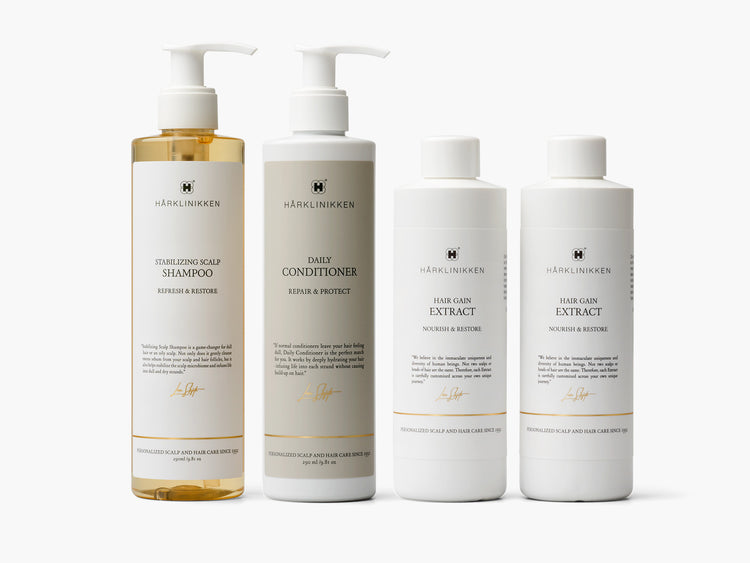
Our award-winning Stabilizing Scalp Shampoo is a clarifying formula designed to deeply cleanse product buildup, mineral buildup, and excess oils from the hair and scalp. Formulated with our proprietary astringent burdock root, this shampoo works to remove residue without disrupting the scalp's natural moisture balance — an important consideration, as over-stripping the scalp may trigger compensatory sebum production and further congestion around the follicle.
Used as part of a considered hair and scalp routine, an effective clarifying shampoo may be one of the more meaningful steps a person can take to support follicle health, particularly for those living in hard water regions, which much of the United States is.
What does magnesium actually do for hair and scalp health?
While the topical application of magnesium may not deliver the follicular benefits often attributed to it, magnesium as a systemic nutrient does play a meaningful role in hair and scalp health when considered through the lens of overall physiology.
Magnesium contributes to protein synthesis, and since hair is composed almost entirely of the protein keratin, adequate magnesium levels may support the structural integrity of each strand. Magnesium also plays a role in regulating calcium within cells, managing inflammation pathways, and supporting the function of hundreds of enzymes involved in cellular energy production.
When magnesium levels are insufficient, the body tends to prioritize its use for essential functions such as cardiac and neurological activity. Hair, which is not considered a vital tissue, may be among the first to reflect a nutritional shortfall, which is why systemic deficiency is worth taking seriously, even if a topical spray is unlikely to resolve it.
What we take away from the magnesium study
What we can draw from the magnesium study isn’t so much that magnesium applied to the scalp supports hair growth, but that the hair is so closely tied with all the biological mechanisms of the rest of the body.
The researchers of the study used hair mineral analysis (HMA), an established research technique that is known to be highly reliable. HMA uses the first 3 to 4 cm closest to the scalp hair to analyze the nutritional and the mineral composition of the hair over the previous six to eight weeks. Hair is a metabolically active tissue and as it forms, provides a permanent record of activity occurring within the body during its period of growth.
HMA is able to provide indications of imbalances, deficiencies and excesses of many essential and toxic minerals and can provide a comprehensive picture.
This aligns with our belief that hair health is directly tied to overall bodily wellbeing.
Hair health starts from within
What hair mineral analysis reinforces is something Hårklinikken has long held to be true: the condition of the hair and scalp reflects what is happening within the body as a whole. Nutritional status, gut health, and metabolic function may all influence the environment in which healthy hair is able to grow.
The gut, in particular, deserves attention — it is where nutrients are absorbed, and how efficiently the body processes what it takes in may have a direct bearing on the nourishment that reaches the hair and scalp. Probiotics, found naturally in fermented foods such as yogurt, sauerkraut, and kimchi, play a meaningful role in supporting digestion and nutrient absorption.
With this in mind, our Hair Supplement was developed for over 11 years by our founder Lars Skjøth in collaboration with triple board-certified dermatologist Dr. Panos Vasiloudes. This comprehensive formulation supports hair density, strength, and overall scalp health by addressing eight key contributors from within simultaneously: three biological triggers (stress, gut imbalances, nutrient deficiencies) and five essential growth factors.
It contains Lactobacillus casei for daily gut support, alongside Panax Notoginseng and Astragalus Membranaceus to support nutrient absorption through the gut wall. Further clinically studied ingredients address specific aspects of hair and scalp health: Organic Pea Shoot for denser-looking hair, saw palmetto for natural DHT-blocking activity, D-biotin for bioavailability, pomegranate extract for antioxidant support, and KSM-66® Ashwagandha Root for stress-related shedding.
Should you use magnesium spray on your hair and scalp?
Based on the current evidence, applying magnesium spray directly to the hair and scalp is unlikely to stimulate hair growth or remove mineral deposits in the way that has sometimes been suggested online. The study most frequently cited in support of these claims does not appear to have been read in full, and conclusions drawn from it may have travelled further than the science itself.
That said, ensuring adequate magnesium levels through diet or appropriate supplementation may support overall health in ways that indirectly benefit the hair and scalp. As our Chief Scientific Officer, Dr. Panos Vasiloudes, MD, PhD, and triple-board certified dermatologist, notes, “It is important to eat whole food from diverse sources, grown organically in soil rich with trace elements.”
If you are concerned about thinning hair, mineral buildup, or scalp congestion, a more evidence-led starting point may be a thorough hair and scalp consultation, which takes your full health picture into account, rather than reaching for a single ingredient as a solution.
Hair and scalp concerns are rarely simple, and they are rarely solved by a single product. Meaningful, lasting improvement tends to come from a considered, personalized approach, which is precisely what Hårklinikken has been built upon.
by Heather Lim